CleanFlow Lite
A WhatsApp-first recurring job scheduler for small residential cleaning companies. CleanFlow Lite helps owners organize recurring cleaning jobs, assign cleaners, prevent scheduling confusion, and automatically keep workers and customers informed without requiring the whole team to use complicated field-service software
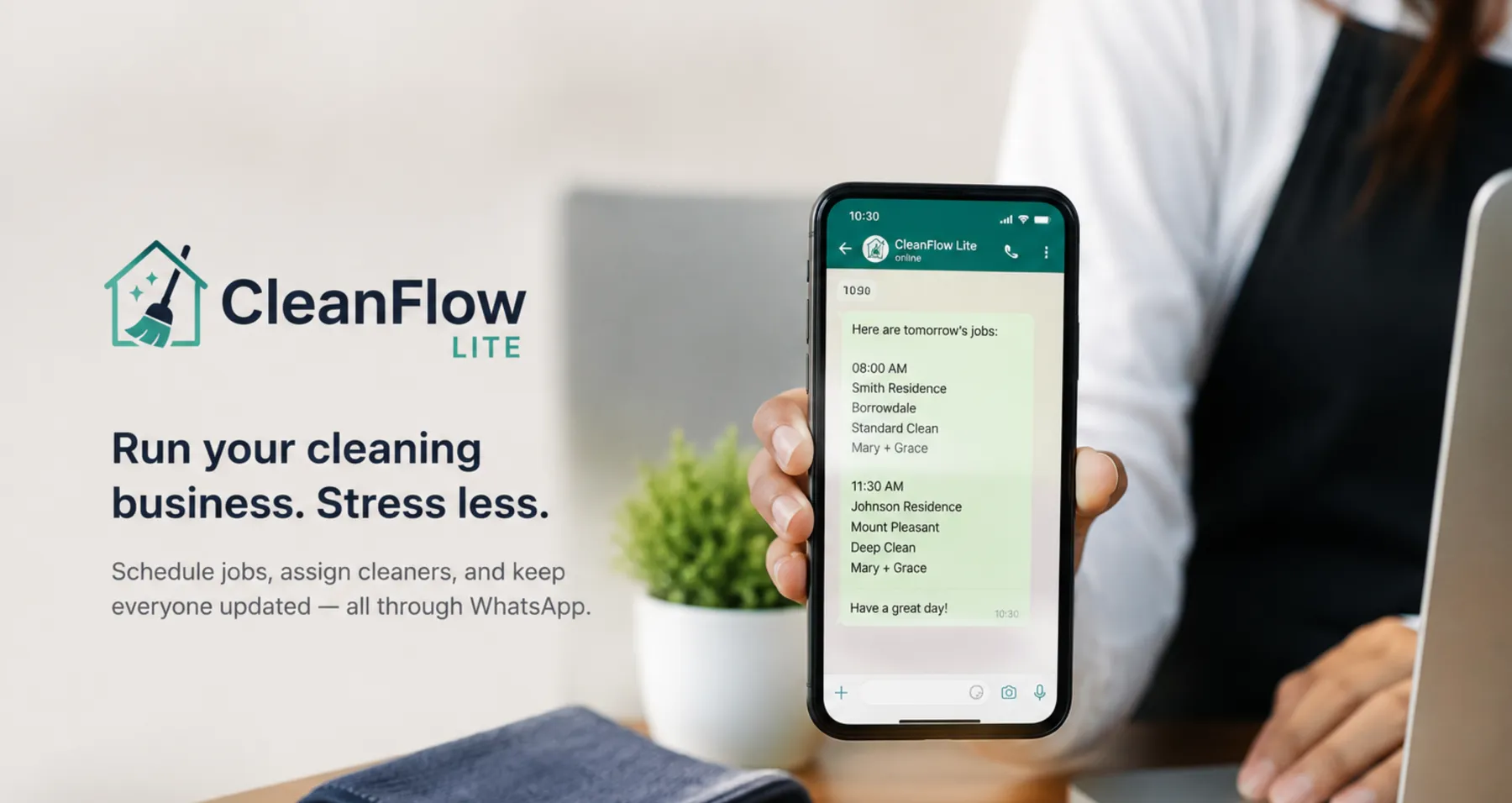
Tomorrow — 22 July
8:00 AM
Smith Residence
Borrowdale
Standard Clean
Assigned: Mary + Grace
11:30 AM
Johnson Residence
Mount Pleasant
Deep Clean
Assigned: Mary + Grace
Workers could also receive a secure link with simple actions such as:
Start Job → Complete Job → Report Issue
Customers could receive automatic reminders before scheduled appointments.
This creates structured operations for the business owner without forcing every cleaner to learn a complicated field-service application.
Why customers may pay
Cleaning-business scheduling is already a proven software category.
Products such as ZenMaid, Jobber, Housecall Pro, BookingKoala and ServiceM8 demonstrate that cleaning and field-service companies already pay monthly subscriptions for scheduling and business-management software.
CleanFlow Lite would not compete by simply being cheaper.
Its differentiation would be simplicity and a WhatsApp-first workflow for very small cleaning teams.
The key hypothesis is:
Small cleaning companies may prefer software that works around communication tools their employees already use instead of requiring every worker to adopt another full business application.
This hypothesis must be validated before serious development begins.
MVP
The first version should remain extremely focused.
Customers
Store:
- Name
- Phone number
- Address
- Cleaning instructions
Cleaners
Store:
- Name
- Phone number
- Availability
Jobs
Each job contains:
- Customer
- Date
- Time
- Duration
- Assigned cleaner
- Job status
Recurring jobs
Support:
- Weekly
- Every two weeks
- Monthly
Calendar
Allow the owner to view:
- Today
- Tomorrow
- This week
Cleaner assignment
The owner selects which cleaner or cleaning team is responsible for each job.
WhatsApp notifications
Send scheduled job information directly to cleaners.
Customer reminders
Send reminders such as:
Your cleaning is scheduled tomorrow at 10:00 AM.
Job status
Support:
- Scheduled
- In Progress
- Completed
- Cancelled
What not to build initially
Avoid turning the MVP into a complete field-service platform.
Do not initially build:
- AI scheduling
- Route optimization
- GPS tracking
- Payroll
- Accounting
- Payments
- Employee analytics
- Inventory management
- Marketing automation
- Advanced CRM
- AI receptionist
- Review management
The initial product should solve scheduling and communication extremely well.
Business model
CleanFlow Lite would use a straightforward monthly SaaS subscription.
A possible starting structure:
Starter — $19/month
Suitable for small cleaning teams with approximately 10 cleaners or fewer.
A future Growing Team plan could be introduced around $39/month as additional functionality is added.
WhatsApp messaging costs may eventually need to be charged separately depending on usage and messaging-provider costs.
Competitive advantage
The biggest competitors already provide powerful scheduling functionality.
That means CleanFlow Lite cannot succeed simply by recreating their features.
The opportunity is to be deliberately smaller.
The positioning would be:
You don't need an entire field-service operating system. You just need your cleaning schedule under control.
CleanFlow Lite would focus especially on businesses moving from:
WhatsApp + spreadsheets → structured scheduling software
rather than trying to convince established companies to migrate away from mature platforms.
How to validate it
Do not begin by building the full product.
First create a simple landing page with the message:
Stop Managing Your Cleaning Team Through Endless WhatsApp Messages
Schedule recurring cleaning jobs, assign cleaners and keep your team updated through WhatsApp from one simple dashboard.
Schedule → Assign → Notify → Done.
The primary call to action should be:
Join the Early Access List
Ask interested owners:
- How many cleaners do you manage?
- How many jobs do you handle each month?
- How do you currently manage scheduling?
- How do cleaners receive their schedules?
- What is the biggest scheduling problem in your business?
Then interview approximately 30 cleaning-company owners.
The goal is not to convince them that the idea is good.
The goal is to discover whether the problem is painful enough that they would actually use the product.
Finding the first customers
Potential customers can be found through:
- Google Maps
- Facebook cleaning-business groups
- Cleaning-company directories
- Reddit communities
- Local cleaning-business associations
Search for owner-operated residential cleaning companies and contact them individually.
The first goal should be approximately 30 customer conversations and five businesses willing to test an early beta.
Validation signals
Strong signals include a business owner who:
- Gives contact information
- Agrees to participate in a beta
- Shows their current scheduling process
- Complains strongly about manual coordination
- Asks when the product will be available
- Introduces another cleaning-company owner
- Asks whether the system could be built for their business
The strongest signal would be a customer asking:
"When can I start using this?"
Risks
Existing competitors may already be good enough
Cleaning-specific platforms such as ZenMaid already provide affordable scheduling software.
CleanFlow Lite therefore needs a meaningful workflow advantage rather than simply a lower price.
WhatsApp-first may not matter
The WhatsApp approach is still a hypothesis.
Cleaning companies may prefer employees using dedicated mobile applications.
Customer interviews must determine whether WhatsApp genuinely improves adoption.
Switching software is difficult
Large cleaning companies may already have years of customer information, schedules and employee records inside existing systems.
CleanFlow Lite should initially target businesses adopting their first structured scheduling platform.
Kill criteria
Do not build the product if customer research shows weak demand.
Consider abandoning the idea if:
- Fewer than roughly 8 out of 30 targeted owners report serious scheduling problems
- Most owners say their current system already works well
- Businesses show little interest in WhatsApp-based coordination
- A targeted landing-page test produces almost no serious signups
- None of the interviewed companies agree to test a free beta
Customer evidence should determine whether development continues.
Technical feasibility
The product is realistic for a solo developer.
A possible stack:
Backend
- Python
- Django
- Django REST Framework
- PostgreSQL
Frontend
- Flutter Web for the owner dashboard
- Flutter mobile applications later if needed
Core backend entities
- Company
- Customer
- Cleaner
- Job
- Recurring Schedule
- Availability
- Job Assignment
- Notification
Cleaners may not need an application during the first version.
WhatsApp messages containing secure job links could provide the necessary worker workflow while significantly reducing development complexity.
Opportunity score
78/100 — Validate further
The opportunity is attractive because the market already exists, customers already pay for scheduling software, prospects are relatively easy to identify and the focused MVP is achievable by a solo developer.
The biggest uncertainty is whether the WhatsApp-first approach is valuable enough to create meaningful differentiation from existing cleaning-management software.
Verdict
VALIDATE — DON'T CODE YET
CleanFlow Lite has:
- A proven software category
- Clear customer pain
- Existing willingness to pay
- Recurring subscription potential
- A manageable MVP
- Easily identifiable customers
- Strong solo-founder suitability
However, competition is significant and the WhatsApp-first differentiation remains unproven.
The next step is customer discovery, not development.
Find 20–30 residential cleaning companies, speak directly with their owners and determine how painful scheduling and employee coordination really are.
If multiple owners actively want the solution and several agree to test a beta, CleanFlow Lite becomes a strong candidate for development.
Would you consider starting this business?
Vote on the opportunity, then share practical context that helps other founders.